Home Koh Samui Thailand Samui Hotels About
Home  ›  Asia  ›  Thailand  ›  Koh Samui  ›  Big Buddha
🇹🇭 Koh Samui · North-coast temples

Big Buddha, Koh Samui
Wat Phra Yai + Wat Plai Laem · temples by the sea · free, near the airport

The Big Buddha (Wat Phra Yai) is a golden seated Buddha around 12 m tall on Koh Faan, a small islet joined to Samui's north-east corner by a short causeway, minutes from the airport — climb the naga staircase to pay respects and take in the view over Bangrak Bay, then drive about five minutes to Wat Plai Laem, where a white 18-arm Guanyin (Goddess of Mercy) stands on a lake. Both are free to enter (donation boxes welcome), and together they make the best half-morning on the north coast.

Get to know it

What the Big Buddha is — and why it belongs in every Samui trip

If you had to pick one image that stands for Koh Samui, many people would pick the Big Buddha (Wat Phra Yai) — a golden seated Buddha around 12 m tall, in the earth-touching posture, on Koh Faan, a small islet off the island's north-east corner joined to Samui by a short causeway road. Built in 1972, it has become the landmark you can spot before you even set foot on the island — planes descending into Samui Airport pass close enough that on many flights you can see the golden figure from the window (if you are sitting on the right side).

The temple itself is compact and does not take long to walk, but what you take home is the island's signature picture: the naga staircase leading up to the Buddha, the upper terrace looking out over the long curve of Bangrak Bay with planes drifting down in the distance, and the little market of souvenirs and snacks at the base of the steps. About five more minutes by car is Wat Plai Laem, where a tall white 18-arm Guanyin (Goddess of Mercy) stands on a lake beside a giant smiling laughing Buddha — the two temples sit so close together that most visitors do both in a single half-morning.

Best of all, both are free (donation boxes are there if you want to give), and the location is conveniently "on the way" for the whole north coast: minutes from the airport, right by Bangrak Beach and its pier, and close to Bophut's Fisherman's Village — so it works as a first stop after landing, a last stop before flying out, or a break between beach days. Get the full picture of the island's sights at the Koh Samui attractions guide.
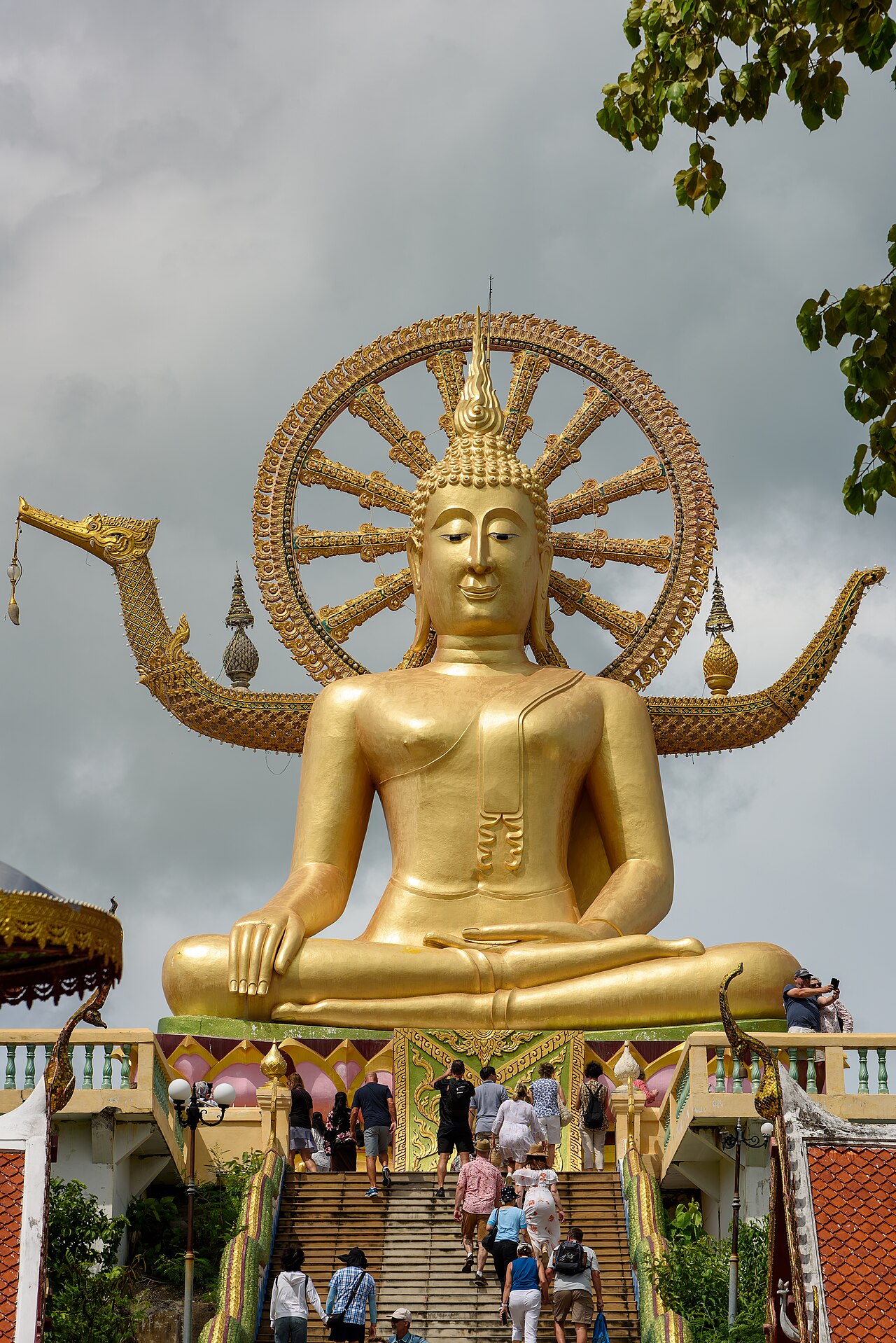
The Big Buddha of Koh Samui (Wat Phra Yai) — a golden seated Buddha around 12 m tall on Koh Faan, with the naga staircase leading up to it
The Big Buddha (Wat Phra Yai) on Koh Faan — the golden 12 m Buddha that is the landmark of Koh Samui's north coast
🛕
What it is
Two north-coast temples
Wat Phra Yai (Koh Faan) + Wat Plai Laem, ~3 km apart
🎟️
Entry
Free, both temples
Donation boxes · give what you wish
Hours
Daytime, roughly
~07:00–18:00, check on the day · morning is best
📍
Location
North-east corner
By Bangrak Beach · ~5–10 min from the airport
👗
Dress code
Cover shoulders + knees
Shoes/hats off in worship zones · cover-ups usually lent
🚕
Getting there
Car + scooter + songthaew
No train or metro on the island · agree taxi fares first
What you'll find

Four beats of a north-coast temple morning — from the naga stairs to the Guanyin lake

These two temples are not a jump-out-take-a-photo stop — they have a rhythm: climb, pay respects, take in the view, browse the market, then move on to a second temple that looks nothing like the first.

Ever visited a famous temple and come away thinking "it was just a big statue" because you rushed it? Give these two a half-morning and follow the rhythm: start at Wat Phra Yai while the sun is still gentle, climb the steps, pay your respects, stand with the bay view for a while, browse the market at the base — then drive on to Wat Plai Laem, which feels like a different world: from a hill temple over the sea to a temple wrapped around a lake and ringed with brightly coloured statues.

What to see

The key sights at both temples — what to look for, where

🙏 The Big Buddha itself — around 12 m, earth-touching posture

The principal image of Wat Phra Yai is a seated Buddha in the earth-touching (Mara-subduing) posture — right hand reaching down to the ground — golden from head to base and around 12 m tall, built in 1972 on the rise of Koh Faan. It faces out toward the sea, visible from far away and even larger up close, with a golden dharma-wheel halo behind it. On Buddhist holy days the temple gets especially lively — this is a living temple the local community actually uses, so walk it with respect and it gives back far more than a photo stop.

🐉 The naga staircase, the bells and the view terrace

From the temple courtyard, the naga staircase climbs to the terrace circling the Buddha's base. On the way up there are bells to ring, in the Thai merit-making tradition. At the top you can walk a full circle around the statue, and the open terrace looks across Bangrak Bay and the whole north shore — on a clear day you can see toward Koh Phangan. Plane-spotters get a bonus: flights sink across the bay toward Samui Airport at regular intervals. All free; about 45 minutes to an hour covers it comfortably.

🛍️ The market at the base, and Bangrak Beach out front

Back down the steps is the temple market — stalls of souvenirs, beach clothing, jewellery and Thai snacks, with prices open to a friendly haggle. Just beyond it is Bangrak Beach (often called Big Buddha Beach after the temple), a long shallow beach far quieter than Chaweng, with beachfront restaurants that work well for lunch straight after the temple. Nearby, Bangrak pier runs fast boats to Koh Phangan and Koh Tao on some sailings — if you are catching a boat, a temple stop first is a natural fit.

🪷 Wat Plai Laem — the 18-arm Guanyin on the lake

The star of Wat Plai Laem is the tall white statue of Guanyin, the Goddess of Mercy, with 18 arms fanned out around her like rays. She stands in the middle of the lake so that she seems to float on the water — go in the morning when the lake is still and you get the full mirror reflection. The temple is free to enter, with donation boxes and worship areas that local people genuinely use.

😊 The giant laughing Buddha and the lake-borne ordination hall

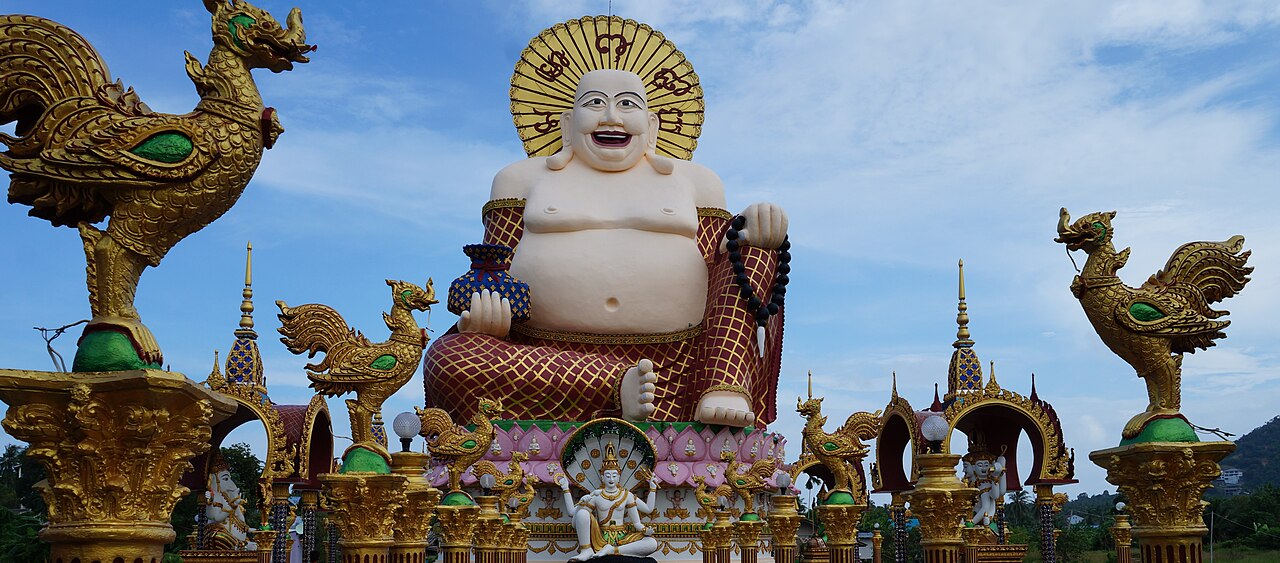
Across the lake sits the giant laughing Buddha — a huge white smiling figure with a round belly, framed by golden pillars and archways in a riot of detail that makes children gasp. Between the two big statues, the ordination hall stands in the water, reached by a short bridge, with stucco work and murals worth a slow look inside. A full lap of the lake takes around half an hour to an hour — and do not skip the bag of fish food for the well-fed fish in the lake, a favourite with families.

The giant white laughing Buddha at Wat Plai Laem, Koh Samui, framed by golden pillars and archways beside the temple lake
Wat Plai Laem — the giant laughing Buddha beside the temple lake, only about five minutes by car from the Big Buddha
Before you go

Dress code, etiquette — and when to go

Both are working temples, not theme parks — a little preparation makes the visit smoother and shows the place the respect it deserves.

👗 Dress modestly: shoulders and knees covered, shoes off in worship zones

The same rules as any Thai temple: cover your shoulders and knees, men and women alike (vest tops, swimwear and very short shorts are not appropriate), and take off shoes and hats before entering the worship areas. Do not climb on or lean against the Buddha images and statues for photos, and keep voices low where people are praying. Cover-up cloths are usually available to borrow or rent for a small fee at the entrance, but the easiest move is to keep a light scarf in your bag from the moment you leave the hotel — one cover-up works for both temples.

⏰ Morning wins — and temples work year-round, whatever the sea is doing

The best window is around 08:00–10:00: the heat has not built yet, the crowds are thin, and the morning light on the golden Buddha beats any other hour. Tour groups tend to arrive from late morning into the afternoon. The temples are open through the daytime, roughly 07:00–18:00 — check on the day. The quiet advantage of a temple morning is that it does not depend on the sea: the Gulf coast's rains fall hardest October–December, and on a rough-water day when swimming is off, these two temples are the north coast's best fallback — just pack an umbrella. See the month-by-month picture at the best time to visit Koh Samui.

Staying nearby

Where to stay — if you want the temples before the crowds

Both temples sit on the island's north-east corner, between the airport and the Plai Laem headland — anywhere on the north coast reaches them in 10–20 minutes.

Closest of all is the Bangrak–Plai Laem–Choengmon stretch, within a few minutes of both temples — quiet, near the airport, and suited to anyone who wants a calm beach and an easy morning flight. Next is Bophut and the Fisherman's Village, about 10 minutes away, with the island's most pleasant evening scene of restaurants, cafés and a waterfront stroll. And if you base yourself in Chaweng, the island's main beach hub, the temples are about a 20-minute drive — an easy half-morning out before going back to the sand.

We would not choose a hotel on temple distance alone — both temples are an easy reach from every northern base. Pick the beach style you want first, and the temples become a stop you can slot in any day. Compare the areas properly before you decide.

How to get there

Getting to Wat Phra Yai and Wat Plai Laem

The two temples sit on the island's north-east corner, close to the airport and the ring road, and are an easy reach from every north-coast beach — there is no train or metro on Koh Samui, so you move by car, scooter and songthaew.

✈️
From Samui Airport (USM)
~5–10 min by car
Very close · works before/after a flight · agree the fare first
🏖️
From Bophut / Fisherman's Village
~10 min by car
Along the north-coast ring road · close enough to cycle
🌆
From Chaweng
~20 min by car
Return charters with waiting time exist — settle the price first
🛵
Rented scooter
Easiest if you ride
Parking at the temple · wear a helmet · Samui's roads see many accidents
🚐
Songthaew
Cheapest (by day)
North-coast runs on the ring road · ask for "Big Buddha" · check the fare first
🛕
Between the two temples
~3 km · ~5 min by car
Do both back-to-back in one half-morning
Getting-around tip for Samui: Samui's taxis are famously expensive and do not use meters — always agree the fare before you get in. Ride-hailing apps exist but cars are limited. Songthaews run semi-fixed routes by day and are far cheaper (after dark they switch to charter pricing, a different game entirely). A rented scooter gives the most freedom, but be honest with yourself about your riding and bring a licence. Read the full picture in the getting around Koh Samui guide and the Samui airport transfer guide.
Plan your visit

A temple route — half a morning, or a full north-coast day

⏱️ Half-morning (~3–4 hours · done by lunch)

08:00 — Arrive at Wat Phra Yai in the soft light: climb the naga staircase, pay respects, circle the Buddha, take in the Bangrak Bay view
09:00 — Browse the market at the base of the steps over a cold coconut
09:30 — Drive about five minutes to Wat Plai Laem: the 18-arm Guanyin, a lap of the lake, feed the fish
11:00 — Continue to Bophut's Fisherman's Village for a café stop or a waterfront lunch
12:30 — Back to the hotel with the whole afternoon free for the beach

🌇 Full north-coast day (+ Choengmon Beach + a Bophut sunset)

Carrying on from the half-morning above:
13:30 — Spend the afternoon at Choengmon Beach, a quiet bay with calm water near the temples — swim or read under an umbrella
16:30 — Stop by Bangrak Beach in front of Wat Phra Yai for a shot of the golden Buddha in the late light from the sand
17:30 — Head into the Fisherman's Village: wander the lane of old shophouses and wait out the sunset by the water (Friday night brings the walking street — crowded but fun)
19:00 — Dinner at a waterfront restaurant in Bophut to close a proper north-coast day

Want the whole island threaded into one trip — beach days, temple morning, island tour? See the day-by-day plan in the 3-day Koh Samui itinerary and the full list of sights at the Koh Samui attractions guide.

The staircase up to the Big Buddha on Koh Samui, with visitors climbing toward the golden statue
The steps up to the Big Buddha — arrive before 10:00 for the best light and the quiet before the tour groups
Frequently asked questions

FAQ · Big Buddha + Wat Plai Laem, Koh Samui

Where is the Big Buddha (Wat Phra Yai) on Koh Samui, and how do you get there?
The Big Buddha sits on Koh Faan, a small islet off Koh Samui's north-east corner joined to the main island by a short causeway road, right by Bangrak Beach and only a few minutes (around 3 to 4 km) from Samui Airport (USM). From Chaweng it is roughly a 20-minute drive; from Bophut and the Fisherman's Village about 10 minutes. The easiest way is a taxi or a car arranged by your hotel — Samui taxis do not use meters, so always agree the fare before you get in — or a rented scooter (there is parking at the temple). By day, songthaews run along the north-coast ring road; tell the driver you want the Big Buddha. Wat Plai Laem is about another 3 km, around five more minutes by car. There is no train or metro on Koh Samui. Read more in the getting around Koh Samui guide.
Are Wat Phra Yai and Wat Plai Laem free, and what should you wear?
Both temples are free, with no ticket — there are donation boxes if you want to give. Dress as you would for any Thai temple: cover your shoulders and knees (men and women), and take off your shoes and hat before entering the worship areas. Do not climb on or lean against the Buddha images and statues. Cover-up cloths are usually available to borrow or rent for a small fee at the entrance, but it is easier to carry a light scarf or wear knee-length clothing from the start. The open terraces get very hot in the middle of the day, so bring water, a hat (removed in the worship zones) and sunscreen.
What is there to see at Wat Plai Laem, and how is it different from the Big Buddha?
Wat Phra Yai is about the single golden Buddha, around 12 m tall, and the sea view from its upper terrace. Wat Plai Laem is about the statuary set around a lake — a tall white 18-arm Guanyin (Goddess of Mercy), a giant smiling laughing Buddha, and an ordination hall that stands in the water. You can circle the lake for photos and buy a small bag of fish food to feed the fish. The two temples are only about 3 km apart, so most people visit both back-to-back in one half-morning, allowing roughly 45 minutes to an hour at each. See the island's other sights at the Koh Samui attractions guide.
When is the best time to visit, and how long does it take?
The best window is the early morning, around 08:00 to 10:00 — the heat is gentler, the crowds are thinner and the morning light on the golden Buddha is at its best. Tour groups tend to arrive from late morning into the afternoon. The temples are open through the daytime, roughly 07:00 to 18:00 — check on the day. Allow about 45 minutes to an hour at each temple, or a half-morning for both including the drive. Temple visits work year-round because they do not depend on sea conditions, but October to December is the rainy season on the Gulf coast, so pack an umbrella or rain jacket then. See the month-by-month picture at the best time to visit Koh Samui.
What can you do nearby after the temples?
Samui's north coast has plenty to follow with — Bangrak Beach is right in front of Wat Phra Yai, with beachfront restaurants and a long walkable shore; Choengmon Beach, a short drive on, is quieter with calmer water; and Bophut's Fisherman's Village is a lane of old wooden shophouses with restaurants, cafés and waterfront bars that comes into its own from late afternoon to sunset (Friday night brings the walking street market). Near the temple, Bangrak pier runs fast boats to Koh Phangan and Koh Tao on some sailings. If you are planning the whole trip, the 3-day Samui itinerary strings all of this together.
Klook · Koh Samui tours & activities

Temples done — now the sea: island tours around Samui and airport transfers

Book Ang Thong Marine Park tours, Koh Tao and Koh Phangan day trips, and Samui airport transfers in advance on Klook — clearer prices than haggling on the spot, with several operators to compare in one place.

See Koh Samui activities on Klook →
Wherebest is a Klook affiliate partner — we may earn a commission when you book through our links, at no extra cost to you.